Оставьте свое сообщение

China Best RFID Laundry Tags for Textile Washing?

Industrial laundries handle thousands of garments, towels, and uniforms every day. Manual counts can miss items between collection, washing, finishing, and delivery. RFID offers a practical way to record those movements, but tag choice matters as much as the reader.

GS1’s EPC standards provide a common framework for identifying and reading RFID-tagged items across supply chains. For laundry operations, buyers should also examine the tag’s tested wash-cycle life, temperature limits, chemical resistance, and attachment method. A tag sewn into a garment seam faces repeated heat, pressure, and detergent exposure. One failed seam can make an otherwise reliable system difficult to trust.

The market opportunity is real, though headline growth figures do not guarantee savings at a specific facility. Reports from firms such as Grand View Research track expansion in the broader RFID market, while GS1 documentation helps explain the identification standards behind many deployments. Neither source replaces a controlled laundry trial. Test representative fabrics, loading conditions, and reader locations before choosing a supplier. Small details matter. The search phrase “Текстильная Rfid бирка для стирки” points to the same practical need: a textile RFID laundry tag that remains readable after repeated industrial washing. Buyers comparing China Best RFID Laundry Tags for Textile Washing should ask for documented test results, traceability, and clear warranty terms. Claims deserve verification.

China Best RFID Laundry Tags for Textile Washing?

What Are RFID Laundry Tags for Textile Washing?

RFID laundry tags are small, washable identifiers attached to garments, towels, or linen. Each tag carries a unique electronic code that a reader can capture without seeing the label directly. In a busy laundry, staff can scan a bundle of sheets at once instead of reading individual barcodes. The code links each item to records such as its owner, wash count, and current location. That makes the tag a tracking tool, not a detergent or cleaning component.

A laundry tag must survive repeated heat, water, pressure, and chemical exposure. Buyers should check its rated wash cycles, operating temperature, attachment method, and readability after testing. Details matter. A tag sewn into a hem may suit a uniform, while a flat tag may be better for a towel. GS1’s RFID guidance describes item-level identification as a way to improve stock visibility; Auburn University’s RFID Lab has also reported high inventory accuracy in retail RFID studies. Those results are useful context, but they do not guarantee the same performance in a laundry. Real performance depends on tag placement, reader setup, fabric, and handling. One awkward truth: even durable tags can fail when poorly attached.

How RFID Laundry Tags Work in Industrial Laundry Operations

China Best RFID Laundry Tags for Textile Washing?

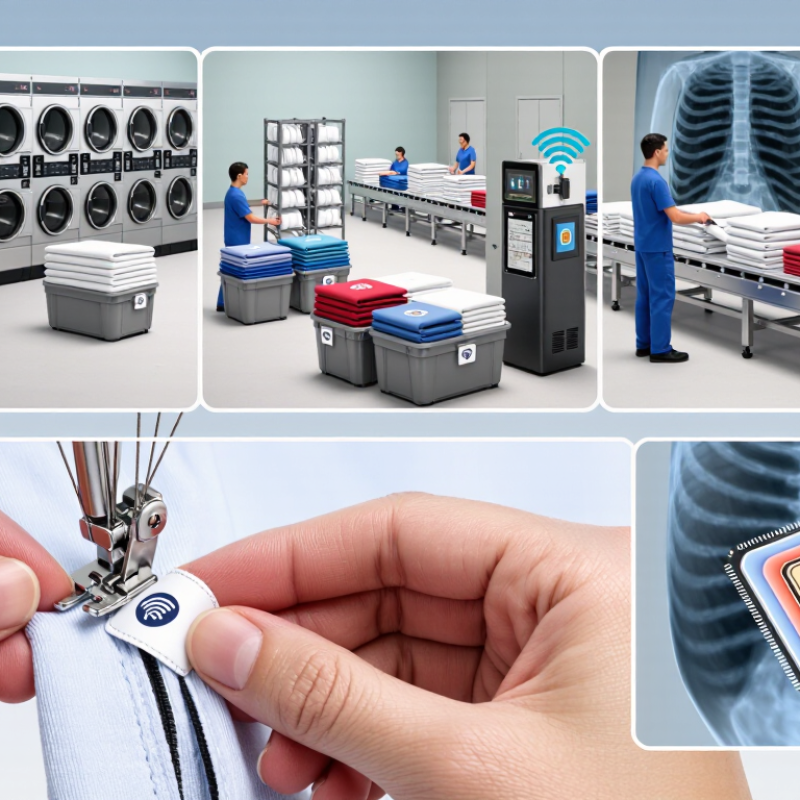
In industrial laundry operations, RFID tags help identify garments and linens without scanning each item by hand. A small tag is sewn into a hem or attached to a textile according to its use. At intake, readers capture the tag’s unique identifier as laundry passes through a collection point. The system can then record an item’s arrival, sorting group, and movement between processing stages. It is a practical workflow, though not magic.

After washing and drying, tagged items may pass another reader before packing or delivery. Staff can compare recorded counts with the physical load and investigate mismatches. For example, a hotel’s white towels can be grouped by batch, making missing pieces easier to spot.

Tags must be selected and tested for the facility’s wash temperatures, chemicals, and mechanical stress. Placement matters, too. A poorly positioned tag may cause discomfort or fail sooner. Reader range, metal equipment, and densely packed loads can also affect reads, so real-world trials are worth the effort. Data can be incomplete. Manual checks still matter. Reliable tracking depends on sound tag installation, calibrated equipment, and clear handling procedures—not the tag alone.

Key Features of China-Made RFID Laundry Tags

Key Features of China-Made RFID Laundry Tags

China-made RFID laundry tags are designed to keep working through repeated washing, drying, and pressing. Their value depends less on appearance than on whether they survive a real laundry cycle. Check the stated temperature range, pressure tolerance, and resistance to detergents before choosing a tag. A small tag sewn into a linen hem should not crack or loosen after routine handling. Details matter.

Tag size and attachment method affect both comfort and reading performance. Sew-in styles suit many garments, while other formats may fit larger textile items. Ask for the chip frequency and test read range with the equipment used at your facility. Wet bundles, metal carts, and tightly packed sheets can change results. A sample test is useful. One wash is not enough.

Reliable suppliers should provide clear specifications and test information, including cycle conditions and sample quantities. Compare those records with your own washing process rather than relying on a broad “industrial washable” claim. Batch consistency also deserves attention: inconsistent dimensions or stitching can slow tagging work. I would still inspect samples myself; paperwork cannot reveal every weak seam. A practical trial helps expose small problems before they spread across daily operations.

China Best RFID Laundry Tags for Textile Washing? - Key Features of China-Made RFID Laundry Tags
Tag Format Typical Construction Common RFID Standard Laundry Process Suitability Attachment Method Common Applications Selection Notes
Flexible textile label Textile or polymer housing with an embedded UHF inlay Typically EPC Class 1 Gen 2 / ISO 18000-6C Designed for repeated commercial laundry cycles; allowable temperature, pressure, and cycle count depend on the model Sewing into a hem or attaching to a textile label Uniforms, workwear, and reusable garments Check flexibility, dimensions, read performance when folded, and documented wash-cycle testing.
Button-style tag Compact, rigid housing enclosing an RFID inlay Typically UHF EPC Class 1 Gen 2 / ISO 18000-6C Can be specified for industrial washing and drying; verify resistance to the actual process conditions Sewing onto the garment or securing through a reinforced area Garments requiring a compact, durable identifier Confirm that the housing and attachment point will not damage fabric or interfere with garment use.
Heat-seal tag RFID inlay laminated with a heat-activated adhesive layer Typically UHF EPC Class 1 Gen 2 / ISO 18000-6C Suitable only when the adhesive and tag have been validated for the intended wash and drying cycles Heat pressing onto compatible textiles Items where stitching is undesirable or difficult Check the required press temperature, pressure, dwell time, fabric compatibility, and resistance to repeated laundering.
High-temperature rigid tag Encapsulated inlay in a robust polymer housing Typically UHF EPC Class 1 Gen 2 / ISO 18000-6C May be specified for demanding wash, extraction, or drying processes; ratings vary by construction Sewing, pocket insertion, or another approved mechanical attachment Industrial textiles and reusable items exposed to intensive processing Request test conditions and results for temperature, pressure, chemicals, and cycle count rather than relying on a general “washable” claim.
HF laundry tag Encapsulated high-frequency inlay, commonly operating at 13.56 MHz Often ISO/IEC 15693 or another compatible HF protocol Wash resistance depends on the tag construction and its verified process rating Typically sewn into or attached to the textile Short-range identification and systems designed around HF readers Choose HF when the reader system requires it; confirm interoperability with the existing equipment.
UHF laundry tag Encapsulated UHF inlay designed for longer-range bulk identification Typically EPC Class 1 Gen 2 / ISO 18000-6C Available in versions intended for repeated textile washing; exact endurance is model-specific Sewing, heat sealing, or mechanical attachment, depending on the model Inventory counting and identification of multiple textiles Read range varies with reader power, antenna, tag orientation, nearby liquids or metal, and installation.
Important: Specifications and performance vary among manufacturers and models. Before purchasing, request a datasheet and test evidence for the intended washing, drying, pressing, chemical exposure, and service-life requirements. The values above describe common product categories and are not a guarantee for any particular tag.

How to Choose the Best RFID Tags for Textile Washing

Choosing an RFID tag for textile washing starts with the laundry cycle, not the reader. Check the tag’s rated temperature, pressure, and chemical resistance against your actual wash, drying, and sterilization processes. A tag that survives ordinary washing may fail during repeated high-heat drying. Ask for documented test results, and compare them with your facility’s conditions.

Fit matters too. Flexible, low-profile tags are less likely to create discomfort in uniforms or snag in sheets. Consider how each tag will be attached: sewn into a hem, placed in a pocket, or heat-sealed. Then confirm that readers can detect it through damp, folded, or densely stacked textiles. Small details count. Frequency, encoding, and data format should match your existing system, so verify compatibility before ordering at scale.

Run a pilot with the fabrics you use most. Wash and dry sample items repeatedly, inspect the attachment, and record missed reads. Include bulky towels and thin garments; they behave differently. One test is not enough. I would not trust a supplier’s durability claim without seeing how the tag performs in your own workflow. Pilot results can reveal weak stitching or inconsistent reads, though they may not represent every future load.

China Best RFID Laundry Tags for Textile Washing? How to Choose the Best RFID Tags for Textile Washing

For UHF RFID laundry tags, confirm that the tag supports the frequency band permitted in the region where it will be used. The chart shows commonly used regional bands: ETSI 865–868 MHz and FCC 902–928 MHz. Regional regulations can vary, so verify current local requirements and test read performance on textiles under your actual washing and handling conditions.

Applications, Benefits, and Maintenance Considerations

RFID laundry tags help identify sheets, towels, uniforms, and garments through washing and sorting. A hotel can link each towel to a linen record; a commercial laundry can scan bags at intake and dispatch. This reduces manual counting, though a missed scan can still create inaccurate records.

The RAIN Alliance’s 2023 industry report recorded 44.8 billion RAIN RFID tag chips shipped in 2022, indicating the technology’s broad adoption. That figure covers many industries, not laundry alone, so it does not prove a particular wash-site return on investment.

Small details matter. Tags should be sewn or sealed as specified, away from folds that trap water or experience heavy friction. Before deployment, test tags through the actual wash cycle, including detergent exposure, extraction pressure, and drying heat. Inspect seams and housings for cracks, then rescan samples regularly. Replace tags that fail.

One practical weakness is that harsh cycles and poor placement can shorten service life; I would not assume a tag’s advertised durability matches every facility’s conditions.